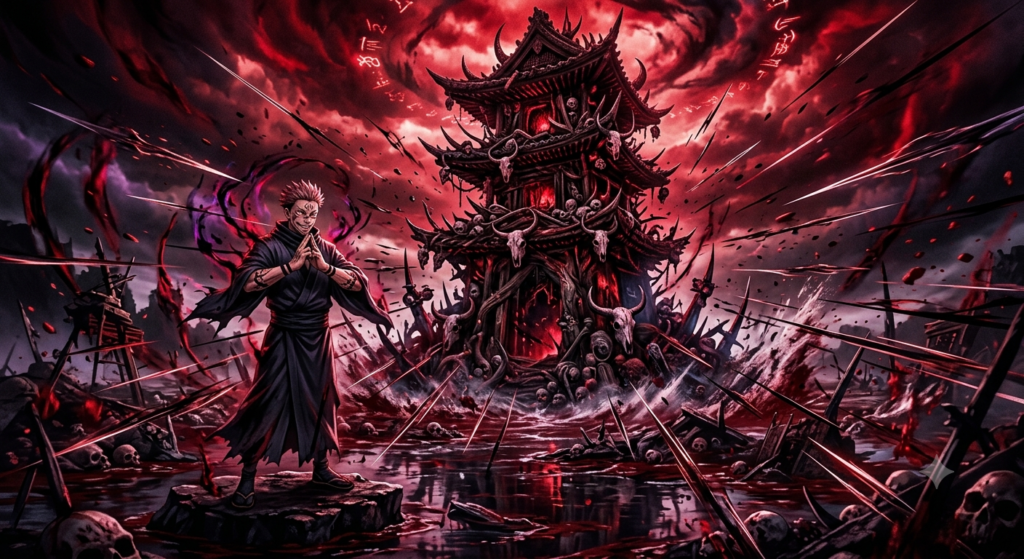
In the world of Jujutsu Kaisen, few techniques inspire the same mix of awe and pure dread as Sukuna Domain Expansion. Known formally as Malevolent Shrine, this ability stands as one of the most refined and destructive expressions of jujutsu ever displayed. When Ryomen Sukuna opens this domain, the battlefield itself becomes a slaughterhouse. Invisible blades rain down without mercy, carving through buildings, cursed spirits, and even the strongest sorcerers until little remains but dust and silence. What sets this technique apart is not just its raw lethality but the sheer mastery required to perform it. Unlike almost every other domain expansion in the series, it does not rely on a closed barrier. Instead, Sukuna paints his innate domain directly onto reality, a feat so advanced that characters within the story describe it as divine.
This open-barrier approach creates a binding vow that trades confinement for an enormous effective range, reaching nearly two hundred meters at full power. Inside that radius, Cleave targets anything with cursed energy and adjusts its cutting force to the opponent’s durability, while Dismantle slices through inanimate objects and those without cursed energy. The result is continuous, unavoidable destruction that only ends when Sukuna chooses to close the domain or is injured so severely that he can no longer sustain it. From its first appearance against a Finger Bearer to its repeated clashes with Satoru Gojo during the Shinjuku Showdown, this technique has defined some of the most memorable moments in the manga and anime. Understanding how it works, why it is so difficult to counter, and what it reveals about Sukuna’s character offers a deeper appreciation of both the power system and the story’s central antagonist.
Understanding the Fundamentals of Domain Expansion in Jujutsu Kaisen
Domain Expansion represents the pinnacle of a sorcerer’s craft. At its core, the technique involves externalizing one’s innate domain—the mental landscape that reflects a user’s soul and cursed technique—into the physical world. Most practitioners achieve this by constructing a barrier that isolates a pocket of space. Within that sealed environment the user’s technique becomes guaranteed to hit, creating a sure-hit effect that bypasses many forms of defense. The barrier also intensifies the technique’s output and can impose unique environmental conditions tailored to the user’s abilities. Because constructing a lethal domain demands precise control over cursed energy, barrier techniques, and the innate domain itself, only a handful of characters in the series ever reach this level.
The rarity of true Domain Expansion underscores its value in combat. Grade 1 sorcerers may spend years refining their techniques yet still fail to open a complete domain. Those who succeed gain an overwhelming tactical advantage. The enclosed space prevents escape, the sure-hit property ensures attacks land, and the user’s cursed energy efficiency often improves. Yet this standard model carries weaknesses. Destroying the outer shell can collapse the domain. A more refined opposing domain can overpower it. Escape techniques or simple domains can sometimes mitigate the sure-hit effect. These limitations make the conventional approach powerful but not absolute.
Sukuna’s approach discards the conventional model entirely. By refusing to enclose his domain, he creates a binding vow that expands its effective area dramatically while removing the vulnerability of an outer shell. This decision reflects both his immense talent and his personality. As the King of Curses who once dominated the Heian era, Sukuna has little interest in trapping opponents inside a cage. He prefers to impose his will on the existing world, forcing everything within range to submit to his blades. The difference is not merely technical; it is philosophical. Where most sorcerers create a separate stage for their power, Sukuna turns the entire stage into his domain.
The Appearance and Symbolism of Malevolent Shrine
When Sukuna Domain Expansion activates, a grotesque structure materializes. The shrine resembles a distorted Buddhist zushi or chinjudō, but every element has been twisted toward the demonic. Bovine skulls form the base. Horns protrude from the hip-and-gable roof. Smaller mouths open in the gables. Fanged mouths appear at the corners of the entrances. Human skulls hang from the four corners of the roof. The overall impression is of a sacred space that has been defiled and repurposed to enshrine something far darker than any traditional deity.
This visual design is rich with symbolism. Sukuna’s historical connection to records in the Nihon Shoki already paints him as a figure of dual nature—both man and curse, both king and monster. The shrine’s bovine imagery and demonic mouths reinforce that duality. The structure does not simply house power; it announces Sukuna’s presence as something that has corrupted the sacred. In a series where cursed techniques often reflect the user’s psychology, Malevolent Shrine stands as one of the clearest examples. It is not a clean, geometric space like Unlimited Void. It is organic, unsettling, and openly malevolent.
The lack of a barrier means the shrine exists fully within the real world. Buildings, streets, and bystanders all become part of the domain’s canvas. During the Shibuya Incident the technique reduced large sections of the city to rubble, demonstrating how thoroughly the sure-hit effect interacts with ordinary matter. The shrine itself remains the focal point, a visual reminder that everything within the radius belongs to Sukuna for the duration of the expansion.
How Cleave and Dismantle Function Inside the Domain
The true lethality of Sukuna Domain Expansion comes from the continuous application of his innate technique. Outside the domain, Cleave requires physical contact and adjusts its power according to the target’s cursed energy and durability so that a single slash can bisect the opponent. Dismantle is a more general slashing attack that works on objects and can be projected at range. Inside Malevolent Shrine both techniques activate automatically and relentlessly across the entire effective area.
Cleave seeks out anything that possesses cursed energy and calibrates its cutting force to that target’s toughness. This adaptive quality makes it especially dangerous against durable opponents. Dismantle handles everything else—buildings, ground, clothing, or individuals whose cursed energy is too low to register for Cleave. Together they create a storm of invisible blades that attack from every direction simultaneously. There is no need for Sukuna to aim or even remain focused on individual targets. The domain handles the work for him.
This automation is one of the technique’s greatest strengths. While other domain users must still direct their techniques to some degree, Sukuna can fight, defend, or simply observe while the domain continues its work. The sure-hit property ensures that even high-speed movement or advanced defensive techniques struggle to avoid every slash. Only abilities that specifically neutralize sure-hit effects, such as Simple Domain or Hollow Wicker Basket, or an opposing domain of equal refinement, offer meaningful resistance.
The Binding Vow That Makes the Open Barrier Possible
The decision to forgo a closed barrier is not a casual one. In the language of jujutsu, it constitutes a binding vow. By allowing potential escape routes, Sukuna strengthens the sure-hit effect and extends its range to a maximum of nearly two hundred meters. This trade-off is classic binding-vow logic: a restriction accepted in exchange for a greater benefit. The result is a domain that covers an area far larger than most closed domains while remaining immune to the common tactic of destroying the outer shell.
Because there is no shell to destroy, the only reliable way to end Malevolent Shrine is to damage Sukuna himself until he can no longer maintain the technique. This requirement raises the bar for any would-be counter. Opponents must either overpower him in direct combat or possess a domain refined enough to match his in a clash while also dealing sufficient damage. During the Shinjuku Showdown, even Satoru Gojo, whose Unlimited Void is described as superior in pure technique, struggled against the open nature of Malevolent Shrine because Sukuna could attack the exterior of Gojo’s barrier from outside.
Sukuna has also demonstrated the ability to modify the conditions of the domain mid-battle through additional binding vows. He can shrink the effective range to spare specific individuals, as he did with Megumi Fushiguro in Shibuya. He can temporarily disable the sure-hit effect inside an opposing domain in exchange for greater external power. Later in the series he even altered hand signs and brain pathways to maintain the domain for a limited time after suffering severe damage. These adjustments reveal a level of control that few other characters approach.
Historical Context and First Appearances
Sukuna Domain Expansion first appeared in the manga during the Fearsome Womb arc and in the anime during Episode 4. At that early stage Sukuna was still operating through Yuji Itadori’s body with limited fingers consumed. Even in that incomplete state the technique proved overwhelming against a special-grade Finger Bearer. The ease with which Sukuna opened the domain and the casual way he used it to finish the fight established him immediately as a threat on an entirely different scale from ordinary curses or sorcerers.
The Shibuya Incident provided a far more dramatic demonstration. Facing Mahoraga, the most adaptive of the Ten Shadows Technique’s shikigami, Sukuna expanded Malevolent Shrine across a large section of the city. The continuous barrage of Cleave and Dismantle, combined with the later use of Divine Flame, ultimately allowed him to overcome Mahoraga’s adaptation. The collateral destruction was immense, reducing buildings to dust and leaving lasting scars on the landscape and on several supporting characters who were caught in the periphery.
These early uses already hinted at the technique’s flexibility. Sukuna could adjust the radius, choose targets with precision, and still maintain enough control to continue fighting. Later battles would push those capabilities even further, but the foundation was visible from the beginning.
Comparison With Other Domain Expansions
Placing Malevolent Shrine alongside other notable domains highlights its unique strengths. Unlimited Void, Gojo’s domain, floods the target’s mind with infinite information, effectively paralyzing them. Its refinement is exceptional, and within a closed barrier it can neutralize even Sukuna’s sure-hit effect during a pure clash. Yet the closed nature of Unlimited Void leaves its outer shell vulnerable to external attacks, a vulnerability Sukuna repeatedly exploited.
Jogo’s Coffin of the Iron Mountain creates a volcanic environment hot enough to incinerate ordinary sorcerers. Dagon’s Horizon of the Captivating Skandha traps targets in an aquatic space filled with shikigami. Mahito’s Self-Embodiment of Perfection allows soul manipulation at close range. Each of these domains is powerful within its own logic, yet none matches the combination of range, continuous damage, and resistance to conventional disruption that Malevolent Shrine possesses.
Even Kenjaku’s Womb Profusion, another open-barrier domain, does not reach the same level of refinement or destructive consistency. The comparison underscores why characters within the story treat Sukuna’s technique with particular caution. It is not simply another domain; it is a domain that operates by different rules.
The Role of Binding Vows in Enhancing the Technique
Sukuna’s mastery of binding vows extends well beyond the foundational open-barrier trade. Throughout the later arcs he continues to invent new conditions that temporarily boost specific aspects of his power. One vow allowed him to fire a world-cutting Dismantle that could sever space itself, though it required subsequent chanting and manual direction for future uses. Another limited Divine Flame so that it could only be used against multiple opponents when inside the domain, in exchange for increased speed and range. A third allowed him to maintain Malevolent Shrine for ninety-nine seconds at full power even after significant brain damage by routing techniques through undamaged pathways.
These vows illustrate a deeper principle. Sukuna treats restrictions not as limitations but as tools. Every condition he accepts is calculated to produce a greater advantage at the moment it is needed. This mindset separates him from many other powerful characters who rely primarily on raw cursed energy or innate talent. Sukuna is a strategist who happens to possess overwhelming power, and the domain is one of the primary stages on which that strategy plays out.
Combat Applications Across Major Battles
In the fight against Mahoraga, the domain served both as a blunt instrument of destruction and as a testing ground. Sukuna observed how the shikigami adapted to successive slashes and adjusted his approach accordingly. The open nature of the domain allowed him to continue applying pressure across a wide area while still engaging the target directly. The eventual introduction of Divine Flame inside the domain created a thermobaric effect that proved decisive.
Against Gojo the domain became a tool of attrition and tactical deception. Multiple domain clashes tested the relative refinement of Malevolent Shrine and Unlimited Void. Sukuna repeatedly used the open barrier to attack from outside Gojo’s domain, forcing Gojo to adapt by shrinking his own barrier or altering its conditions. The exchanges revealed that while Unlimited Void might hold an edge in pure technique quality, the practical advantages of the open barrier and Sukuna’s ability to modify conditions mid-fight kept the contest remarkably even for a long stretch.
Later uses against groups of sorcerers further demonstrated the domain’s area-denial capability. When multiple high-level fighters coordinate against Sukuna, the continuous sure-hit effect forces them to spend energy on defense or simple domains simply to survive, reducing their offensive options. The psychological pressure of fighting inside a space where every second risks another lethal cut cannot be overstated.
Limitations and Possible Counters
No technique is without weakness. Malevolent Shrine still requires significant cursed energy to maintain, especially at maximum range. Severe injury to Sukuna can collapse it. Opposing domains of sufficient refinement can neutralize the sure-hit effect within their own barriers. Techniques that specifically cancel sure-hit properties, such as Simple Domain or domain amplification, provide temporary protection. Characters with no cursed energy, such as Maki after her Heavenly Restriction fully awakens, interact differently with the domain’s targeting logic and may require different defensive approaches.
Yet these counters are rare and often incomplete. Simple Domain must be maintained continuously. Domain amplification drains the user’s resources. An opposing domain must both match refinement and survive external assault from the open barrier. In practice, only a handful of characters have ever forced Sukuna to close the domain, and even then the cost was usually high.
The Cultural and Narrative Significance
Beyond its mechanical power, Sukuna Domain Expansion carries narrative weight. It is the technique that most clearly marks Sukuna as something other than a conventional antagonist. Ordinary villains might possess strong domains. Sukuna possesses a domain that rewrites the rules other characters operate under. The visual of the shrine appearing in the middle of a modern city, the casual way buildings dissolve into dust, and the calm confidence with which Sukuna stands at its center all reinforce his role as a force of nature rather than a mere rival.
The technique also serves as a measuring stick for the protagonists. Yuji’s growth, Megumi’s struggles, and the desperate strategies employed by the remaining sorcerers all gain meaning against the backdrop of this overwhelming ability. When characters survive contact with Malevolent Shrine, the achievement feels significant. When they fail, the loss carries appropriate gravity.
Technical Refinement and Mastery Indicators
Several details signal the extraordinary level of mastery required. The domain activates nearly instantaneously. Sukuna can adjust its radius with precision. He can alter targeting conditions without collapsing the technique. He can maintain it while fighting at full intensity and even while using other high-level techniques such as domain amplification or reverse cursed technique. Most domain users struggle to do more than one thing at a time once the domain is open. Sukuna treats the domain as an extension of his ordinary fighting style rather than a separate mode that demands total focus.
The comparison often drawn in the text itself—that realizing an innate domain without a barrier is like painting a masterpiece on air rather than on a canvas—captures the difficulty. Ordinary sorcerers need the “canvas” of a barrier to stabilize their domain. Sukuna does not. That difference alone places the technique in a category of its own.
Quotes From the Series That Capture Its Essence
One of the most revealing descriptions comes directly from the narrative: “Malevolent Shrine differs from other types of domain expansions in that it doesn’t create a separate space using a barrier. The ability to realize one’s innate domain without using a barrier is akin to an artist painting a masterpiece not on a canvas, but on air. A truly divine technique.”
Another moment that underscores the practical terror occurs during the Shibuya Incident when the sheer scale of destruction becomes clear. The continuous application of Cleave and Dismantle leaves no safe ground within the radius. Characters who survive do so only through extreme measures or pure luck of positioning.
During the Shinjuku clashes, Gojo’s own assessment of the relative refinement of the two domains highlights how evenly matched the techniques are in pure quality, even while the open-barrier advantage continually shifts the practical balance.
Table of Key Characteristics
| Aspect | Description | Strategic Implication |
|---|---|---|
| Barrier Type | Open / barrierless | Immune to outer-shell destruction |
| Maximum Range | Nearly 200 meters | Exceptional area denial |
| Core Attacks | Continuous Cleave and Dismantle | Adaptive and indiscriminate destruction |
| Sure-Hit Property | Present across the entire radius | Extremely difficult to avoid |
| Primary Weakness | Requires Sukuna to remain capable of maintenance | Only ends through severe damage to the user |
| Binding Vow Benefit | Expanded range and strengthened sure-hit | Trade-off for allowing potential escape |
| Activation Speed | Near-instantaneous | Difficult to interrupt |
| Environmental Impact | Affects real-world structures and terrain | Collateral damage is massive |
Evolution of the Technique Across the Story
Early appearances showed the domain as a finishing tool. Later battles revealed its capacity for sustained pressure and tactical modification. By the final arcs Sukuna had demonstrated the ability to reopen the domain after brain damage, to layer additional binding vows onto its conditions, and to combine it with other techniques in increasingly creative ways. The evolution mirrors Sukuna’s own recovery of power as he consumes more fingers and eventually takes full control of a new vessel. Each new application adds layers of complexity that keep the technique feeling fresh even after repeated use.
Why the Technique Resonates With Readers
Part of the appeal lies in its clarity. The rules are straightforward once understood, yet the implications are vast. Readers can follow the logic of the binding vow, the adaptive nature of Cleave, and the practical advantages of the open barrier without needing excessive exposition. At the same time the visual spectacle of the shrine and the sheer scale of destruction create memorable set pieces. The combination of mechanical elegance and raw spectacle is rare, and Malevolent Shrine delivers both.
The technique also humanizes Sukuna in an unexpected way. For all his arrogance and cruelty, the domain is the product of genuine mastery. It is not a power he simply inherited; it is something he refined over a thousand years. That history of craftsmanship gives weight to every activation.
Practical Considerations for Theoretical Matchups
When discussing hypothetical battles, the domain forces careful analysis. Any opponent must either possess a comparable domain, a reliable sure-hit negation, or the raw durability and healing to survive continuous slashes while closing distance. Most characters fail at least one of those tests. Even those who can survive for a time often find their options restricted by the constant pressure. The domain therefore functions as both a weapon and a strategic equalizer that limits the opponent’s ability to use their own strongest techniques freely.
The Psychological Dimension of Facing the Domain
Beyond the physical danger, Malevolent Shrine exerts psychological pressure. Knowing that every second spent inside the radius risks another lethal cut creates urgency. Characters are forced into reactive postures. They must prioritize survival over offense. That shift in mindset is often as damaging as the slashes themselves. Sukuna understands this effect and frequently uses the domain not merely to kill but to control the pace and emotional temperature of a fight.
Closing Thoughts on Mastery and Legacy
Sukuna Domain Expansion stands as more than a powerful ability. It is the purest expression of its user’s philosophy and skill. The open barrier, the adaptive blades, the binding vows, and the divine level of control all combine into a technique that feels inevitable once activated. In a series filled with creative and devastating powers, Malevolent Shrine occupies a special place because it refuses to play by the same rules as everything else. That refusal is what makes it unforgettable.
Conclusion
Sukuna Domain Expansion, better known as Malevolent Shrine, represents the absolute peak of jujutsu mastery. Its open-barrier design, continuous adaptive attacks, and flexible binding vows create a combination of power and versatility that few other techniques can match. From its early appearances to the climactic battles of the later arcs, the domain has shaped the story’s most intense confrontations and forced every major character to confront the reality of fighting the King of Curses at full strength. Understanding its mechanics, history, and narrative role provides a clearer picture of both the power system and the central conflict of Jujutsu Kaisen. As long as discussions of the series continue, this technique will remain one of the defining examples of what true domain expansion can achieve when talent, experience, and ruthless calculation align.
What is the official name of Sukuna Domain Expansion?
The technique is officially called Malevolent Shrine, or Fukuma Mizushi in Japanese. Fans and characters often refer to it simply as Sukuna’s domain, but the formal name captures both its appearance and its ominous nature. The shrine itself is a distorted Buddhist structure filled with demonic imagery, and the name reflects that corrupted sacred space.
How does the open barrier of Sukuna Domain Expansion actually work?
Instead of creating a closed pocket dimension, Sukuna materializes his innate domain directly into the existing space. This creates a binding vow that allows potential escape in exchange for a vastly expanded range and a strengthened sure-hit effect. The lack of an outer shell means the domain cannot be collapsed by destroying a barrier; only severe damage to Sukuna himself ends it.
Can ordinary sorcerers survive inside the domain?
Survival is extremely difficult. The continuous barrage of Cleave and Dismantle leaves almost no safe ground. Characters who have survived did so through specialized techniques such as Simple Domain, extreme healing, or by being outside the adjusted radius. Even then, many suffered permanent injuries or required immediate extraction by allies.
How does Sukuna Domain Expansion compare to Unlimited Void?
In pure technique refinement the two domains are closely matched, with some statements suggesting Unlimited Void holds a slight edge. However, the open nature of Malevolent Shrine allows Sukuna to attack the exterior of closed domains, giving him a practical advantage in prolonged clashes. The two techniques tested each other repeatedly during the Shinjuku Showdown and produced some of the most complex domain interactions in the series.
Why is the range of Sukuna Domain Expansion so large?
The nearly two-hundred-meter radius is the result of the binding vow created by leaving the barrier open. By accepting the risk that targets might escape, Sukuna gains both greater coverage and a more potent sure-hit effect. He can also deliberately shrink the radius when precision is more valuable than maximum area, as demonstrated when he spared specific individuals during earlier battles.