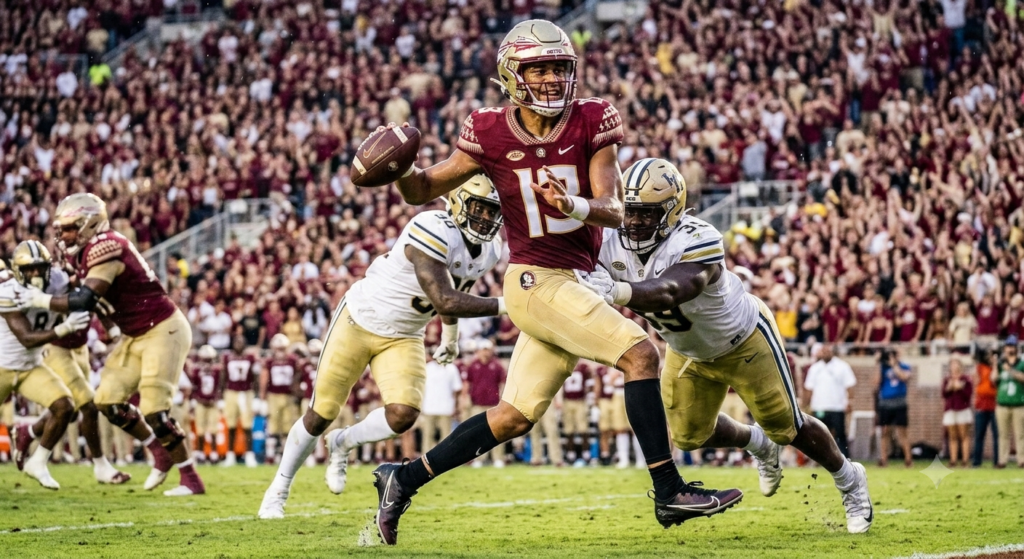
Football careers can shift in a single moment. For one talented quarterback who rose through the ranks at Florida State and earned a shot in the NFL, that moment came on a routine play that left him with a severe lower-body issue. The Jordan Travis leg situation remains one of the more discussed cases in recent college and professional football because of how it cut short a promising path and forced a difficult decision years later. Fans who followed the Seminoles during their strong 2023 run still talk about what might have been, while those tracking the New York Jets saw a fifth-round selection who never got to step on the field in a regular-season game. This article walks through the background, the exact sequence of events, the long recovery road, the eventual retirement, and the broader lessons that come from such a high-profile case. Everything is laid out in clear language so anyone can follow along, whether you watched every game or are just catching up now.
The story starts with a player who had already shown real growth over several seasons. Travis arrived at Florida State after a short stop at Louisville and steadily improved as a dual-threat quarterback. By 2022 and into 2023 he was leading the offense with accuracy, mobility, and leadership that helped the team put together long winning streaks. The 2023 season looked especially promising as the Seminoles sat undefeated and ranked high in the College Football Playoff picture. Then came the non-conference matchup that changed the trajectory. Understanding the full context of the Jordan Travis leg injury helps explain why the recovery proved so challenging and why doctors ultimately advised walking away from the game.
Background on Jordan Travis and His Rise at Florida State
Jordan Travis grew up in West Palm Beach, Florida, and developed into a quarterback known for toughness and athleticism. He began his college career at Louisville before transferring to Florida State, a program he had long admired. Early seasons involved limited action and learning the system under changing coaching staffs. Over time he earned the starting job and put up strong numbers through the air and on the ground. By his junior year he was posting efficient passing stats while also contributing rushing touchdowns, a combination that made him a dual threat defenses had to respect.
In 2022 the Seminoles took a big step forward under his leadership. Travis threw for over three thousand yards with a high completion rate and multiple touchdowns while adding solid rushing production. The team won consistently and earned bowl success. That momentum carried into 2023. Through the first eleven games he completed nearly sixty-four percent of his passes for more than twenty-seven hundred yards, twenty touchdowns, and only two interceptions. He also ran for additional scores. Those numbers put him in the conversation for major awards, including a fifth-place finish in Heisman Trophy voting even after missing the final games. Teammates and coaches often pointed to his competitive fire and ability to elevate those around him.
The program itself was riding high. An eleven-win start had fans dreaming of a playoff berth and possible national title run. Senior Day against a lower-division opponent was supposed to be a celebration. Instead it became the setting for a career-altering moment. Looking back, the foundation Travis built over multiple seasons made the sudden end feel even more abrupt. His statistical output and leadership had restored pride to a fan base that had waited for consistent success. That success made the Jordan Travis leg event stand out as a turning point not just for one player but for the entire season’s narrative.
Beyond the numbers, Travis carried himself with a quiet confidence that resonated with supporters. He spoke often about faith, family, and the daily work required to improve. Those qualities would later surface again during the long months of rehabilitation. For anyone following college football in the early 2020s, his arc represented a classic story of transfer, development, and eventual breakthrough. The injury interrupted that story at its peak, which is why so many still revisit the details years later.
The Exact Moment the Injury Occurred
On November 18, 2023, Florida State hosted North Alabama in Tallahassee. The Seminoles were heavily favored and already sitting at ten wins. Early in the contest Travis scrambled on a designed run or broken play, fighting for extra yards the way he often did. A defender wrapped him up in a manner that many observers later described as resembling a hip-drop tackle. His left leg got caught underneath the weight and twisted awkwardly as he went down. The replay showed the ankle bending in a way that made many viewers wince. Trainers rushed onto the field immediately. An air cast went on, and Travis was carted off while the crowd fell quiet.
Initial reports described a lower-leg injury. Later confirmation revealed a fractured and dislocated left ankle. The play itself looked relatively ordinary until the awkward landing. No one on the field expected a season-ending result against that opponent on Senior Day. Travis was taken for further evaluation and ultimately underwent surgery to stabilize the area with hardware. The diagnosis ended his college career on the spot. He would not return for the final regular-season game or the conference championship.
Videos of the sequence circulated widely. Commentators noted how the leg rolled under the defender’s body, creating the torque that caused the fracture and dislocation. Medical staff handled the immediate care carefully, but the damage was already done. For a dual-threat quarterback who relied on mobility as part of his game, the location and severity of the injury raised immediate questions about long-term function. That single sequence became the defining image of the Jordan Travis leg story for many fans who watched it unfold in real time.
The emotional weight hit quickly. Teammates rallied on the field and later spoke about the shock of seeing their leader leave in that condition. Travis himself later described the moment as the day everything changed. What had been a celebratory afternoon turned into the start of a multi-year recovery process that would test every part of his approach to the game and to life.
Immediate Aftermath and Impact on Florida State’s Season
Florida State still won the game against North Alabama by a wide margin. The team finished the regular season undefeated and claimed the ACC championship. Yet the College Football Playoff selection committee left the Seminoles out of the four-team field, citing the strength of schedule and the injury to their starting quarterback as factors. That decision created lasting debate. Many argued an undefeated power-conference champion deserved a spot regardless. Others pointed to the drop-off in offensive production without Travis as evidence the committee got it right.
Travis watched the selection show from a difficult position, still dealing with the early stages of recovery. He later admitted feeling responsible for the team’s exclusion, even though the injury was beyond his control. That emotional burden added another layer to an already challenging situation. The program that had looked like a national contender with him under center suddenly faced questions about depth and consistency. Subsequent seasons showed how much the offense had leaned on his presence.
For the broader college football landscape, the episode highlighted ongoing conversations about player safety, tackle techniques, and the physical toll of the sport. The hip-drop style of tackle drew renewed scrutiny after several high-profile lower-body injuries around that period. While rule changes and enforcement efforts continued in later years, the Jordan Travis leg case remained a frequently cited example of how quickly a promising campaign can end.
Supporters of the Seminoles still look back on 2023 as a near-miss that left a mark. The winning streak, the ranking, and the individual awards all carried asterisks once the final games played out without their starting quarterback. Travis’s absence shifted the narrative from potential championship run to what-if discussions that continue whenever the team’s recent history comes up.
The Long Road of Rehabilitation and Early Optimism
Surgery stabilized the fractured and dislocated ankle. The recovery timeline initially pointed toward several months of limited weight-bearing, followed by progressive strengthening and return-to-play protocols. Travis approached the process with the same intensity he brought to the field. He spoke publicly about gratitude for small milestones, such as shedding the walking boot in early 2024. At the NFL Scouting Combine he appeared without the boot and expressed confidence he would be ready by May or June.
Those early updates painted a hopeful picture. Travis emphasized daily work, support from family and friends, and faith as anchors during the slower phases. He described sleeping with the boot and the relief of finally putting on regular shoes again. Medical teams monitored progress carefully, and the expectation remained that a full return was possible for the professional level. The dual-threat style that defined his college success would require strong lower-body stability, so every stage of rehab focused on rebuilding strength, range of motion, and confidence in the joint.
Progress reports stayed positive through the spring of 2024. Travis participated in limited throwing sessions and continued structured physical therapy. The New York Jets selected him in the fifth round of the 2024 NFL Draft, viewing him as a developmental option with upside if the recovery held. That selection reflected belief in both his talent and his ability to overcome the setback. For a player who had finished high in Heisman voting despite missing time, the draft moment felt like validation that the Jordan Travis leg injury would not define the entire career.
Yet the body does not always follow the most optimistic timeline. Subtle issues with healing, scar tissue, or joint response can appear months later. Travis continued working through the summer and into the fall of 2024 while listed on the non-football injury list. The Jets managed the situation carefully, allowing the focus to remain on long-term health rather than rushing him onto the field.
Challenges During the Jets Tenure and Setbacks
The 2024 season passed without Travis appearing in a game. He remained on the reserve list while continuing rehabilitation. Reports later indicated differences in perspective about the pace of the return-to-play plan. His agent publicly suggested the organization had pushed the timeline faster than ideal at one point, leading to a setback that required a full stop. Team officials maintained they followed the surgeon’s protocol. Regardless of the exact details, the net result was that the leg never reached the functional level required for NFL competition.
By early 2025 the conversations shifted. Medical evaluations continued, and the cumulative feedback pointed toward a recommendation to step away. Travis had given the process everything for roughly seventeen months. The decision to retire did not come lightly. He released a handwritten statement explaining that despite maximum effort the leg had not responded as hoped. Prayer, consultation with doctors, medical experts, and his agent all led to the same conclusion. The Jets placed him on the reserve/retired list and expressed support for the choice.
That outcome closed a chapter that began with high hopes. A fifth-round pick who arrived with Heisman credentials and a strong college résumé never got the chance to compete in the league. The Jordan Travis leg injury had proven more stubborn than early milestones suggested. For fans who tracked every update, the retirement announcement carried a sense of finality mixed with appreciation for the effort invested.
Later comments from Travis touched on the mental side of the process. The daily grind of therapy, the uncertainty of each checkpoint, and the eventual acceptance of medical advice all required resilience. He has spoken about finding new purpose after the forced exit from the game, including work connected to the Florida State community and media projects with family. Those next steps show how athletes often redefine success once the playing career ends.
Broader Context of Lower-Leg Injuries in Football
Ankle fractures and dislocations present unique challenges for quarterbacks. The joint must handle planting, cutting, and absorbing contact while maintaining the ability to throw with balance. Hardware from surgery can limit certain ranges of motion or create long-term discomfort under the repetitive stress of practices and games. Even when imaging looks solid, functional testing sometimes reveals deficits that prevent safe return at the highest level.
College and professional programs have refined protocols over the years. Early mobilization, progressive loading, and sport-specific drills all aim to restore athletes as completely as possible. Still, individual biology varies. Some players return stronger; others face persistent limitations. The Jordan Travis leg case illustrates the second category. Despite diligent work and professional support, the desired response never fully materialized.
Conversations about tackle techniques continue in both the NCAA and NFL. Rules targeting certain styles of contact seek to reduce lower-body injuries without removing the physical nature of the sport. Education for players and coaches, improved equipment, and better field surfaces all form part of the larger safety effort. High-profile examples like this one keep the discussion visible and encourage ongoing evaluation of best practices.
For younger athletes watching the story, the takeaway is not solely about risk. It also covers the importance of listening to medical advice, maintaining perspective during setbacks, and recognizing that identity extends beyond the uniform. Travis has modeled that broader view in his public comments since retiring.
Statistical Snapshot of a Standout College Career
To appreciate what the injury interrupted, it helps to look at the production Travis delivered before that November afternoon. The following table summarizes key career numbers across his stops at Louisville and Florida State.
Season | Team | Games | Completions-Attempts | Passing Yards | Passing TDs | Interceptions | Rushing Yards | Rushing TDs 2018 | Louisville | 3 | 4-14 | 71 | 1 | 1 | 40 | 0 2019 | Florida State | 4 | 6-11 | 79 | 0 | 0 | 228 | 3 2020 | Florida State | 8 | 72-131 | 1056 | 6 | 6 | 559 | 7 2021 | Florida State | 10 | 122-194 | 1539 | 15 | 6 | 530 | 7 2022 | Florida State | 13 | 226-353 | 3214 | 24 | 5 | 417 | 7 2023 | Florida State | 11 | 207-324 | 2756 | 20 | 2 | 176 | 7 Career Totals | Combined | 49 | 637-1027 | 8715 | 66 | 20 | 1950 | 31
These figures show steady improvement and dual-threat capability. The 2022 and 2023 seasons in particular stand out for efficiency and scoring production. That body of work earned respect across the conference and nationally. The Jordan Travis leg injury arrived just as the peak years were still unfolding, which is why the statistical record feels incomplete to many observers.
Personal Reflections and Quotes That Capture the Journey
Travis has been open about the emotional side of the experience. In his retirement statement he wrote: “On November 18, 2023, my life took an unexpected turn. I gave everything I had to the rehab process but despite all my efforts, my leg never responded the way we hoped. After much prayer and consultation with the doctors, medical experts and my agent, I’ve been medically advised to retire from the game I love so deeply.”
Earlier, during the recovery phase, he expressed gratitude for small steps: “I got my boot off about a week ago, so it’s pretty special. I look down at my shoes, and I’m so grateful. It’s been a journey, for sure, my family has helped me get through.”
Those words reflect both the disappointment and the resilience that defined the process. Teammates and coaches often described him as a leader who stayed engaged even while sidelined. The support network around him—family, medical staff, and the Florida State community—played a central role in helping him navigate the uncertainty. Quotes like these humanize a story that could otherwise stay focused only on medical details or draft outcomes.
In later interviews Travis has spoken about finding purpose beyond playing. Involvement with university-related initiatives and media projects with his brother have given him new avenues to stay connected to sports and to share lessons from the experience. The Jordan Travis leg chapter closed one door while opening others that continue to develop.
Lessons for Athletes, Fans, and the Sport Itself
Every high-level injury carries lessons. For athletes the clearest one is the need for patience and honest communication with medical teams. Pushing too hard or ignoring warning signs can create longer setbacks. For fans the story serves as a reminder that the players they cheer for face real physical and mental costs. The excitement of a highlight-reel scramble can turn into months of difficult rehabilitation in an instant.
Programs and leagues continue refining safety measures. Better education on tackle form, stricter enforcement of existing rules, and investment in recovery science all aim to reduce the frequency of career-threatening lower-body injuries. No system eliminates risk entirely, yet incremental improvements matter. Cases such as this one keep the conversation active and encourage accountability at every level.
On a personal level the journey shows that identity does not rest solely on athletic performance. Travis has modeled a measured response—working hard, accepting medical reality, and moving forward with purpose. That approach offers a template for others facing similar crossroads. The Jordan Travis leg injury will remain part of his public story, yet it does not have to be the only chapter people remember.
Looking Ahead and the Ongoing Conversation
Since the retirement announcement, attention has shifted toward what comes next. Travis has stayed visible through community involvement and media appearances. Florida State supporters still celebrate the contributions he made during the turnaround years. The Jets organization wished him well and moved forward with their quarterback depth chart. Across the broader football community the discussion occasionally returns when similar injuries occur or when safety rule proposals surface.
The 2023 season remains a point of reference for debates about playoff selection criteria and the value of undefeated records. Travis’s absence from the final rankings conversation added fuel to those debates. Time has softened some of the immediate frustration, yet the underlying questions about fairness and evaluation methods still surface in annual discussions.
For those who followed the player from his early Florida State days through the draft and retirement, the full arc offers a complete picture of talent, adversity, and adaptation. The Jordan Travis leg injury marked a clear dividing line, but the years on either side of it demonstrate growth and character that extend beyond any single play.
Conclusion
The story of the Jordan Travis leg injury is ultimately one of sudden change, determined effort, and eventual acceptance. From a standout dual-threat quarterback leading an undefeated Florida State team to a fifth-round NFL pick who never played a down, the path was shaped by one awkward tackle on a November afternoon. The fractured and dislocated left ankle required surgery and more than a year of intensive rehabilitation. Despite early optimism and consistent work, the joint never regained the function needed for professional competition. Medical advice led to retirement in the spring of 2025, closing the competitive chapter at age twenty-four.
Throughout the process Travis demonstrated the same competitiveness and gratitude that defined his playing days. Support from family, teammates, coaches, and medical professionals helped carry him through the difficult stretches. The impact reached beyond one player, influencing conversations about Florida State’s 2023 campaign, College Football Playoff selection, and ongoing efforts to improve player safety. Statistical records from his college years remain impressive and serve as a reminder of the talent that was interrupted. Quotes from his statements capture both the disappointment and the peace that came with the final decision.
Moving forward, the focus turns to new roles and continued connection to the game in different forms. Fans who watched the rise will remember the leadership and production. Those who followed the recovery will recall the resilience. Together those elements form a complete narrative that goes well beyond any single injury. The Jordan Travis leg story stands as a modern example of how quickly football can change a life and how character shows itself in the response that follows.
What exactly happened during the play that caused the Jordan Travis leg injury?
On November 18, 2023, during Florida State’s game against North Alabama, Travis scrambled and was tackled in a manner that trapped his left leg underneath the defender. The ankle twisted severely, resulting in a fracture and dislocation. He was carted off the field in an air cast and later underwent surgery. That sequence ended his college career immediately and set the stage for the long rehabilitation that followed.
How long did the recovery process last after the Jordan Travis leg injury?
The recovery stretched across roughly seventeen months from the November 2023 injury through the 2024 NFL season. Early milestones such as removing the walking boot in early 2024 brought optimism, yet the leg never reached the functional level required for professional play. Continuous evaluation and therapy continued until medical advice in 2025 recommended retirement.
Did the Jordan Travis leg injury affect Florida State’s College Football Playoff chances?
Yes. The Seminoles finished the regular season undefeated and won the ACC title, but the selection committee left them out of the playoff field. Officials cited the strength of schedule and the absence of their starting quarterback as contributing factors. The decision remains a point of debate among fans and analysts.
Why did Jordan Travis retire from the NFL after the Jordan Travis leg injury?
After spending the entire 2024 season rehabilitating while on the Jets’ non-football injury list, medical evaluations showed the leg had not responded sufficiently. Travis stated that despite maximum effort the joint never reached the hoped-for condition. Consultation with doctors and his agent led to the medically advised decision to retire in April 2025.
What has Jordan Travis done since retiring because of the Jordan Travis leg injury?
He has remained connected to the Florida State community through various roles and has worked on media projects, including a podcast with his brother. Public comments reflect a focus on new purpose, faith, and sharing lessons from the experience. The transition continues to evolve as he builds the next chapter beyond playing.